The 49er’s first real season of the LA28 cycle is over. It ran from the World Championship in Cagliari last October to San Pedro OCR on the LA 2028 waters in August: seven big regattas, 21 podium places, 16 different teams from 15 nations. Seb Menzies and George Lee Rush (NZL 94) won the two championships and Richard Schultheis and Fabian Rieger (GER 11) won Palma and San Pedro. No team in the fleet stood on more than two podiums.
That is the most open the 49er has been since the class’s first Olympic cycle, and no other fleet on the Olympic programme comes close to it this season. Fifteen nations have a result that tells them a medal in Los Angeles is on. Season two decides how many of them even get there.
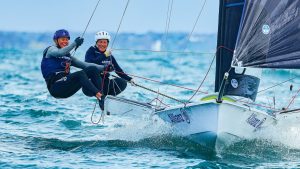
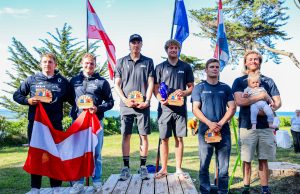
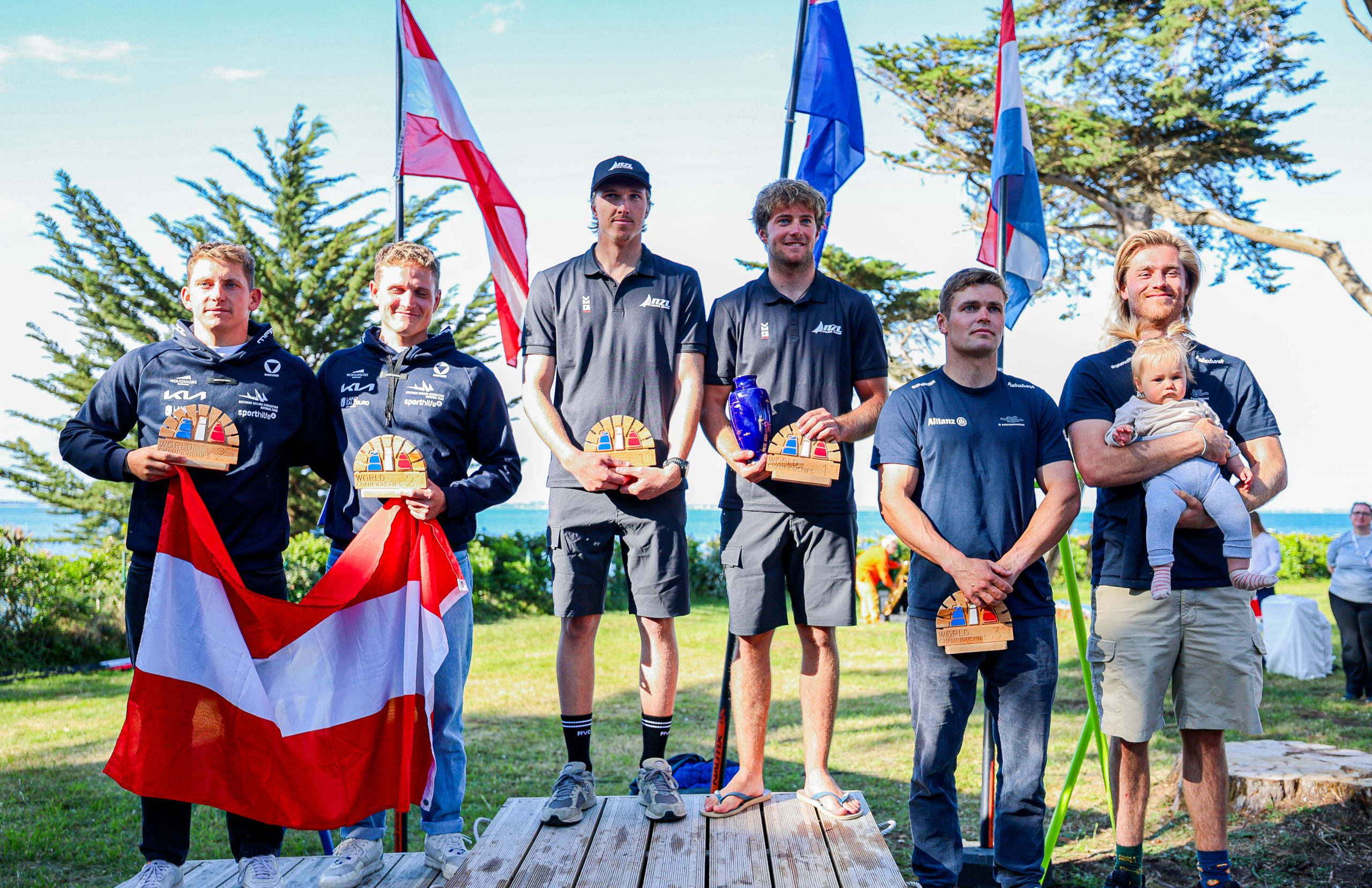
Final day of the 2026 World Championship in Quiberon, where Menzies and Lee Rush took the first world title of the cycle.
Biggest difference maker: nobody could do it thrice
Sixteen teams shared 21 podium places. Five of them managed two podiums: Menzies and Lee Rush, Schultheis and Rieger, Nevin Snow and Ian MacDiarmid (USA 31), Bart Lambriex and Floris van de Werken (NED 2), and James Grummett and Rhos Hawes (GBR 4).
That is the whole list. Nobody made three.
Five different teams won the seven regattas. Menzies and Lee Rush took the Worlds in Quiberon and the Europeans in Eckernförde. Schultheis and Rieger won Palma and then San Pedro. Diego Botín and Florián Trittel (ESP 74) won the Cagliari Worlds, Zaiding Wen and Tian Liu (CHN 33) won Hyères, and Joshua Richner and Nilo Schärer (SUI 133) won Kiel Week.
Fifteen nations reached a podium: Austria, Britain, China, Denmark, France, Germany, Ireland, Israel, the Netherlands, New Zealand, Poland, Spain, Switzerland, Uruguay and the United States. Five continents. Two separate Chinese teams did it at back to back Grand Slam events.
View this post on Instagram
Biggest number: 30
Thirty different teams made a top 10 across the seven regattas, from 18 nations. Gold fleet is 25 boats.
These were not thin fleets either: 84 boats in Cagliari, 101 in Palma, 82 in Quiberon, 90 at Kiel, 93 at the Europeans.
The most consistent crews of the year, Grummett and Hawes and Schultheis and Rieger, made five top 10s each out of seven. Nobody made six.
Best table in Olympic sailing right now
Every Olympic fleet raced its own championships and its share of the Grand Slam regattas over the same eleven months. Here is how many different teams got onto a podium in each of them.
| Event | Regattas | Podium places | Different teams | Teams per place | Nations |
|---|---|---|---|---|---|
| 49er | 7 | 21 | 16 | 0.76 | 15 |
| 49erFX | 7 | 21 | 13 | 0.62 | 11 |
| ILCA 6 | 5 | 15 | 10 | 0.67 | 7 |
| iQFOiL men | 5 | 15 | 10 | 0.67 | 8 |
| ILCA 7 | 6 | 18 | 10 | 0.56 | 9 |
| iQFOiL women | 5 | 15 | 8 | 0.53 | 6 |
| Mixed 470 | 6 | 18 | 8 | 0.44 | 6 |
| Formula Kite women | 5 | 15 | 7 | 0.47 | 6 |
| Nacra 17 | 7 | 21 | 7 | 0.33 | 7 |
| Formula Kite men | 5 | 15 | 6 | 0.40 | 6 |
More regattas gives a fleet more chances to spread its podiums, so the 49er’s seven events flatter it against a five-event class. Cut the 49er back to a matched five regattas and average every combination and it still produces 12.6 different podium teams against 10 for ILCA 6, iQFOiL men and ILCA 7.
The nations column is where it stops being close. Fifteen against a best of eleven anywhere else.
The Nacra 17 row is the other end of the same sport. John Gimson and Anna Burnet were on six of the seven podiums, and three Nacra 17 crews made the top 10 at every regatta. In the 49er, nobody made the top 10 more than five times.
Biggest change: the 49er used to have kings
Look at what this class has been.
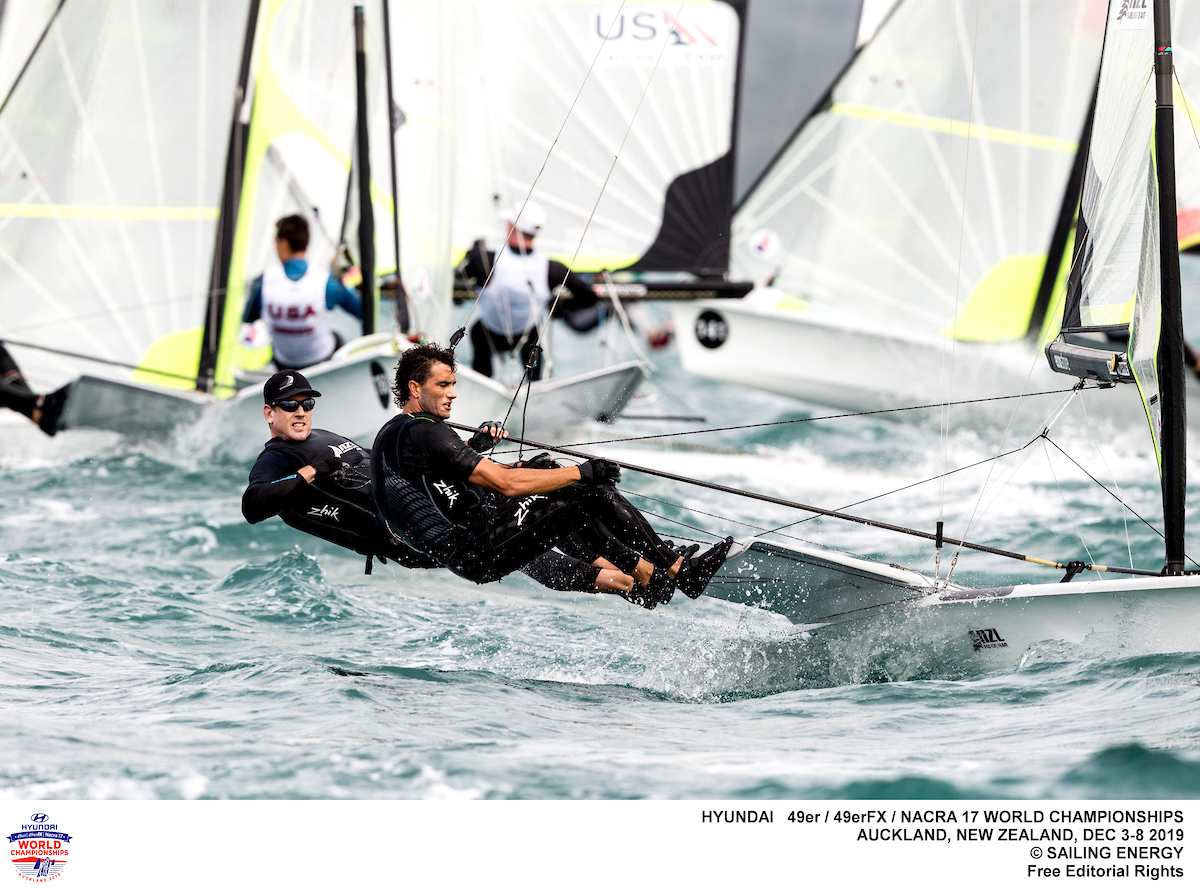
Peter Burling and Blair Tuke won the world title in 2013, 2014, 2015 and 2016, then Olympic gold in Rio. Four world championships in a four year cycle, one crew, one nation. Before them Nathan Outteridge won four titles as helm between 2008 and 2012 and the gold medal in Weymouth. Before that Iker Martínez and Xabier Fernández and Chris Draper and Simon Hiscocks traded the top step through the 2000s, while Martínez and Fernández took gold in Athens and silver in Qingdao.
The last cycle had the same shape. Lambriex and van de Werken won three straight world titles from 2021 to 2023.
This cycle has produced two world champions in two years, from two nations, and neither dominated the season they won in.
Best historical echo: the Sydney quad
The one period that resembles this is the first one, when the boat was new and the whole fleet was learning fast.
Chris Nicholson won the first three world titles from 1997 to 1999. Santiago López-Vázquez and Javier de la Plaza then won the 2000 Worlds for Spain, and at the Sydney Games the medals went to Finland, Britain and the United States, with Jyrki Järvi and Thomas Johanson taking the gold. Not one of the three medal nations had won a world title in the cycle.
Form was spread wider than the trophy cabinet suggested, and the Games went to crews nobody had crowned. That is the closest thing to a precedent for where the class sits now.
Best explanation from inside the fleet
11 October, 2025
© SAILING ENERGY
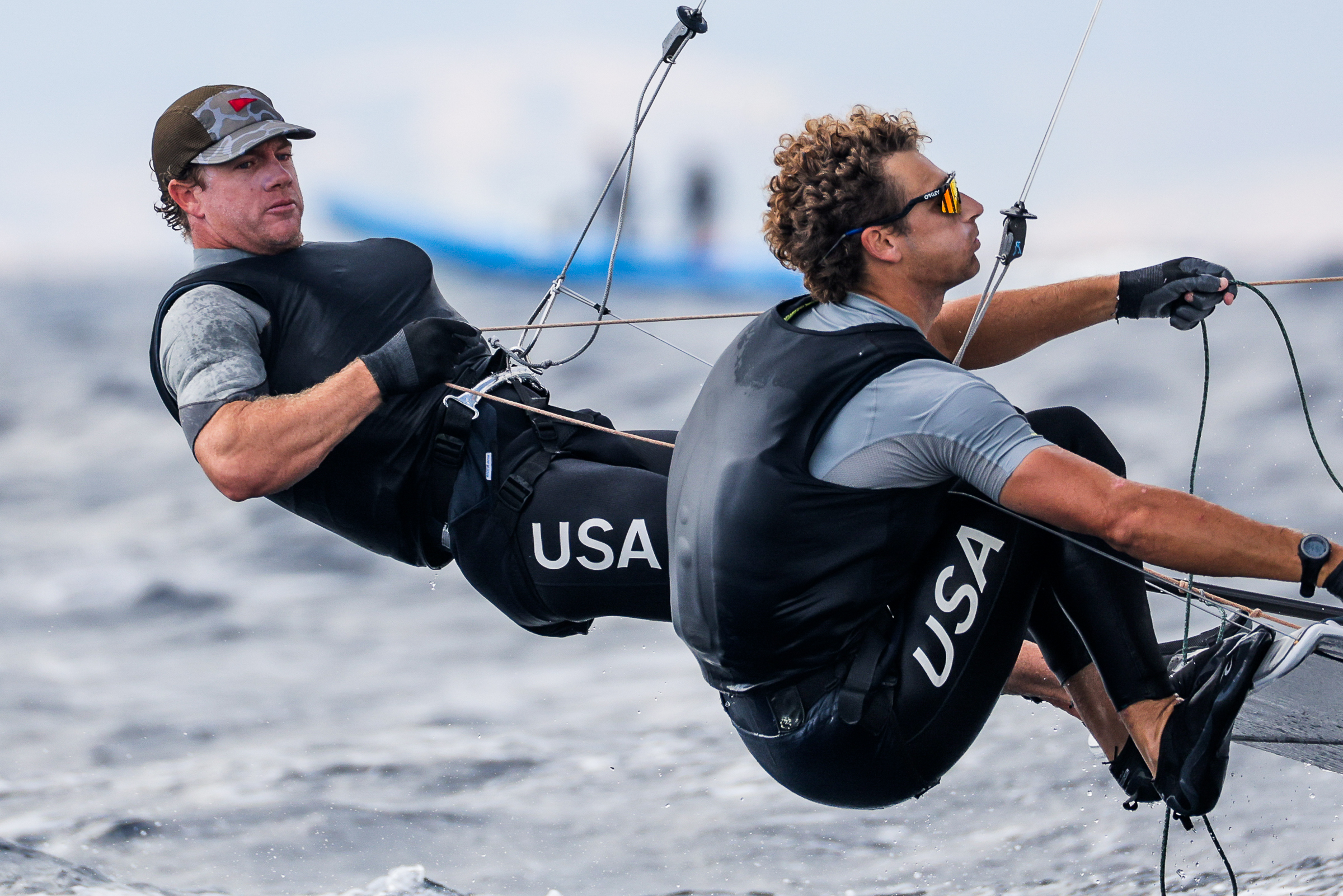
Nevin Snow, who won Hyères in 2025 and was second in Palma this year, puts the parity down to boat speed first.
His read, given to 49er.org: a higher proportion of the fleet is close to maximum boat speed than ever before, and the front half of silver fleet now has top 10 speed. He gives three reasons. Equipment variation has shrunk, with the post-Tokyo masts more consistent and the upwind sails now all built on fixed moulds. The coaching is closer and from a higher level. And any sailor can watch endless high quality 49er footage, from the class and from the coaches’ own cameras, which was not true a decade ago.
Richard Schultheis, who won two of the seven regattas, takes that one step further. His point, also to 49er.org: the old top teams could hold their boat speed and their handling and still do well in a week when they did not sail especially well. Now that so many crews are world class at the basics of moving a 49er, speed and handling only keep you in the game. The winners have to sail well that week too.
That is exactly what the results look like. Five different winners, and each of them had their best week of the year at a different regatta.
The coaching point is checkable, so we checked it. Of the 98 coaches on the entry list at the Quiberon Worlds, 35 are former Olympic sailors and 10 are Olympic medallists, holding 13 medals between them. Three are Olympic champions: Xabier Fernández, Jyrki Järvi and Antón Paz. The class’s golden generation is now standing in the coach boats.
Snow’s other point is about the calendar itself. Almost every regatta served up extremes, strong wind, light wind, offshore breeze, then something steadier, often inside the same week. A specialist in one condition could not ride it for a season.
Biggest doubt, and we tested it ourselves
Three of the seven regattas, Palma, Hyères and Kiel, used a different scoring format from the rest. Qualifying was short, and once the fleets were split into gold and silver, the points from qualifying were wiped. Each boat carried its qualifying rank into finals instead, so first in qualifying started finals on one point, second on two, and so on. Everything that happened before the split was compressed into a single number.
That opens an obvious objection. Maybe the season only looks so open because a scoring quirk handed a couple of trophies to crews who would not have won under normal rules.
So we checked. We took the official race by race results from those three regattas and rescored them the traditional way: every race counts from start to finish, one discard, no reset at the split.
Two winners change. Snow and MacDiarmid take Palma instead of Schultheis and Rieger, and Fischer and Péquin take Hyères instead of Wen and Liu. Kiel stays with Richner and Schärer.
The season as a whole barely moves. Still 16 different podium teams, still nobody with three podiums, and six different winners instead of five. If anything the rescoring makes the year look more open, not less.
The format impacted who won two regattas. It did not manufacture the parity.
Biggest hole in our own case
Two of them. The depth is not new. About 30 teams reach a 49er top 10 in any season, and that was true in 2021-22 and close to true in 2017-18. What changed is that nobody is converting their top 10s into a run of podiums.
And the kings stepped away rather than getting beaten. Botín and Trittel skipped 2026 for the America’s Cup with K-Challenge and the Spain SailGP Team, and they say they will be back in the 49er at Gdynia in 2027. Lambriex took time out of the boat to become a father, returned late in 2025, and still made four top 10s in the seven regattas, including bronze at the Quiberon Worlds. 2017-18, the first season after Burling and Tuke left, was nearly as open as this one, and then Šime and Mihovil Fantela won the 2018 Worlds and the fleet settled back into a hierarchy.
By the way, Fischer and Péquin had the same interruption as Lambriex. Erwan Fischer stepped out for the birth of his child in 2025 and Péquin sailed the next regattas with Erwan’s brother Kevin. The pair still won Palma in 2025 and took bronze in Hyères this year.
View this post on Instagram
Biggest squeeze: fifteen nations, twenty places, and not all of them fit
The upcoming season is where the whole Olympic qualification happens, and it is unforgiving arithmetic.
Twenty boats race in Los Angeles, one per nation. Eight of those places go to nations at the 2027 World Championship in Gdynia, 22 July to 1 August 2027. Six go through continental qualifiers, where two to four nations who did not get a podium this season will take their place in the Olympic fleet. The United States qualifies as host. That leaves five places at the Last Chance Regatta in Europe in early 2028.
Now put the season-one podium list against it. Eleven of the fifteen podium nations are European, and Europe has one continental place. Every one of them is chasing the eight at Gdynia, and whoever misses joins the scrap for five.
At least one nation that stood on a 49er podium this season to miss a spot at the Games. Probably more than one. Add the crews who made a top 10 without a podium, and the Last Chance Regatta in early 2028 is going to be the hardest regatta of the cycle to watch.
How the run in works
The fleet gets its only real break now. After that there is no gap worth the name.
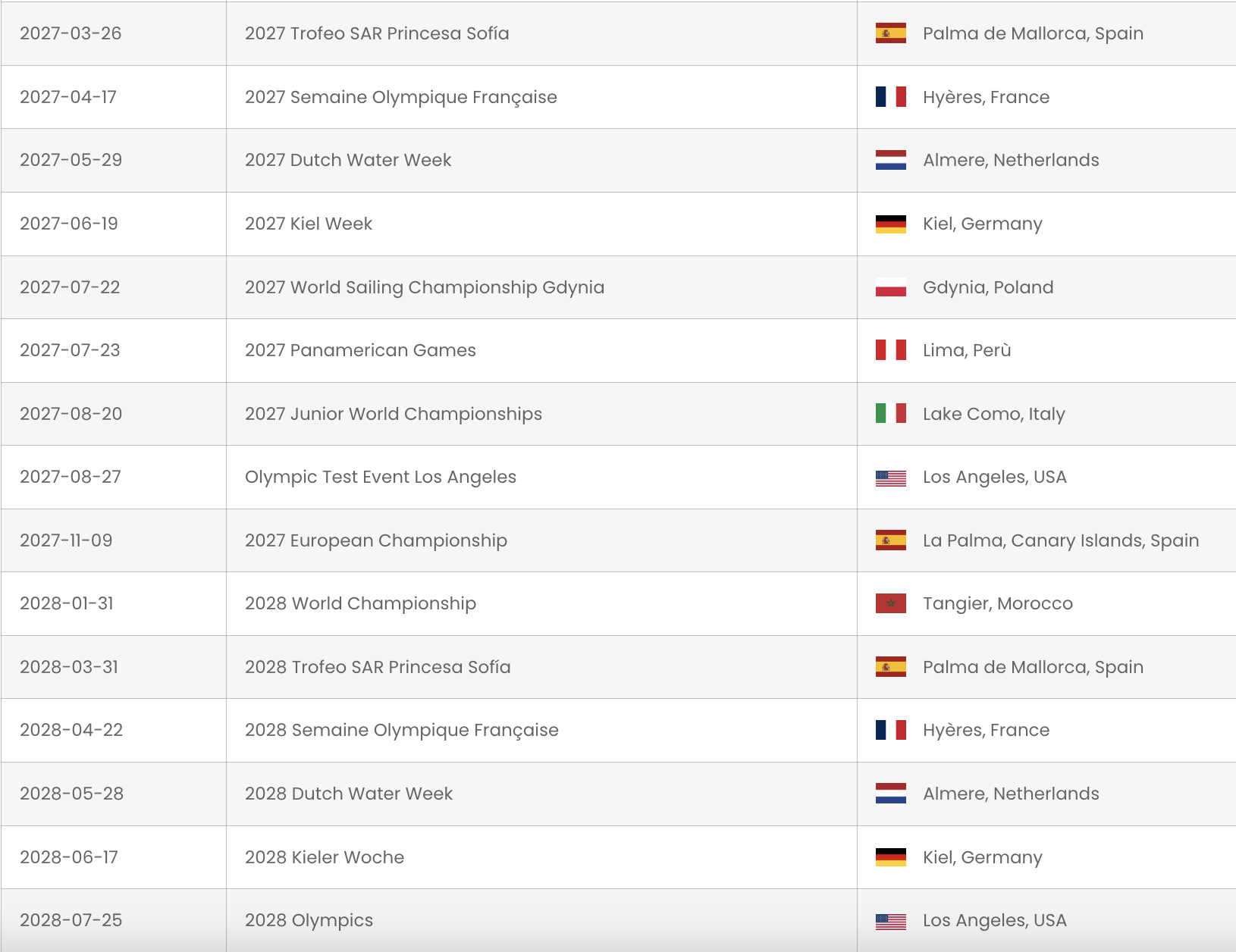
The season starts at the Trofeo Princesa Sofía in Palma on 26 March 2027, then Hyères in April, Dutch Water Week in Almere at the end of May, and Kiel Week in June. Gdynia follows in late July, and three weeks after that the fleet is in Los Angeles for the Olympic Test Event, 27 August to 4 September 2027, on the Games waters.
Then the European Championship on La Palma in the Canaries in November 2027, the World Championship in Tangier, Morocco from 31 January 2028, the Last Chance Regatta, and the Games.
EVENTS IN 2027 TO 2028:
Best ending
Three of the seven trophies went to a crew who won nothing else all year, and the two who won twice never won a third.
Turn up in Palma next March and two dozen crews can believe the next one is theirs. The 49er has not been able to say that since the boat was new.
Season one, the numbers
2025 World Championship, Cagliari, 7-12 October 2025, 84 boats: 1. Diego Botín / Florián Trittel (ESP), 2. Bart Lambriex / Floris van de Werken (NED), 3. Jonas Warrer / Mathias Lehm Sletten (DEN)
Trofeo Princesa Sofía, Palma, 27 March-4 April 2026, 101 boats: 1. Richard Schultheis / Fabian Rieger (GER), 2. Nevin Snow / Ian MacDiarmid (USA), 3. Xin Wang / Tianyu Qi (CHN)
Semaine Olympique Française, Hyères, 18-25 April 2026, 45 boats: 1. Zaiding Wen / Tian Liu (CHN), 2. Robert Dickson / Seán Waddilove (IRL), 3. Erwan Fischer / Clément Péquin (FRA)
2026 World Championship, Quiberon, 12-17 May 2026, 82 boats: 1. Seb Menzies / George Lee Rush (NZL), 2. Keanu Prettner / Jakob Flachberger (AUT), 3. Bart Lambriex / Floris van de Werken (NED)
Kiel Week, 20-24 June 2026, 90 boats: 1. Joshua Richner / Nilo Schärer (SUI), 2. Illy Wureit / Yuval Barnoon (ISR), 3. Nevin Snow / Ian MacDiarmid (USA)
2026 European Championship, Eckernförde, 7-12 July 2026, 93 boats: 1. Seb Menzies / George Lee Rush (NZL), 2. James Grummett / Rhos Hawes (GBR), 3. Mikołaj Staniul / Jakub Sztorch (POL)
San Pedro OCR, Los Angeles, 3-8 August 2026, 31 boats: 1. Richard Schultheis / Fabian Rieger (GER), 2. James Grummett / Rhos Hawes (GBR), 3. Hernán Umpierre / Fernando Diz (URU)
Dutch Water Week in Almere sits outside the analysis: 18 boats, and not the field the other seven were. Its 49er podium was Prettner and Flachberger, Andrew Mollerus and Trevor Bornarth (USA 43), and Robbert Huisman and Jorn Swart (NED 987).
The spring 2025 warm up regattas are also outside the count. They ran from Palma, won by Fischer and Péquin, through Hyères, won by Snow and MacDiarmid, to the Europeans in Thessaloniki, where Menzies and Lee Rush clinched the title with two races still to sail and finished 65 points clear. Nothing like that margin has happened since.
Sources and related coverage
- Results: official Manage2Sail results for the 2025 and 2026 Worlds, Kiel Week and the Europeans; official event results for Palma, Hyères and San Pedro.
- Our coverage: Cagliari Worlds, Palma, Hyères, Quiberon Worlds, Kiel Week, Europeans, San Pedro OCR.
- Background: Botín and Trittel on combining the America’s Cup with LA28, 49er teams to watch in 2026, Palma 2025, Hyères 2025, Europeans 2025, Champions follow a predictable path.
- Calendar: 2027 World Sailing Championship, Gdynia, Olympic Test Event, Los Angeles, 2027 European Championship, La Palma, 2028 World Championship, Tangier.
- Historical records: 49er champions and the 49er World Championship and Olympic records.