As sailing’s fastest league commits to bigger fleets, the sport’s deepest talent pool is already stocked with the next generation of drivers from Gdynia to Medemblik to a training base outside Mumbai.
On a windy weekend in Portsmouth last month, SailGP did something it had only done once before, reluctantly, after things went wrong. It split its fleet in two. Instead of thirteen identical F50 catamarans jockeying for one start line, the kind of “pack push-and-shove” that has caused three serious collisions and hospitalized sailors this season alone, seven teams raced in one group and six in another. The top finishers from each advanced to a final. SailGP first tried this at Halifax out of necessity, when the fleet simply grew too large for one safe start line. What the league realized is that it stumbled into something better than a fix. Two smaller groups racing in quick succession put more boats on the water more often, with less dead time between starts, than one giant fleet ever could. Portsmouth made it the rule for the rest of the season, not a one-off. Nobody flipped. Nobody T-boned a multimillion-dollar wing. SailGP solved, at least for one weekend, a problem it’s been building toward for six seasons. It now has more good teams than it has room for on a single racecourse.
That’s a good problem. And it’s about to get worse in the best possible way.
SailGP CEO Russell Coutts has said the two-group format is here to stay, because incoming expansion teams will make it “seven and seven, then eight and eight, and so forth.” Eight against eight is sixteen boats. SailGP is contracted for fourteen national teams as of now. Artemis Sweden just joined as the thirteenth, with a fourteenth still to be formally named. Do the math and the league still comes up short. To reach sixteen boats, the number Coutts has put on the record as the destination, SailGP needs three more teams minimum beyond what’s already been announced.
The question everyone’s asking: who?
The honest answer is that picking three nations isn’t a talent search. It’s a depth test. A SailGP boat needs six sailors performing at the top of the sport simultaneously. A driver. A wing trimmer. A flight controller. A grinder. A strategist. A reserve who can step in without missing a beat. Every one of those seats has to come from the same small pool of sailors who can actually fly a foiling boat under pressure. One brilliant driver doesn’t cut it. What cuts it is a nation fielding several genuinely competitive 49er and 49erFX pairs at once, year after year, deep enough that losing one doesn’t sink the program.
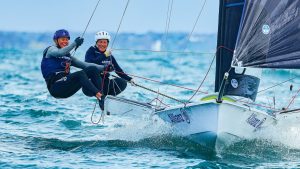
The 49er and 49erFX are the proving grounds for skiff racing at the elite level. This is where SailGP finds its talent. Judged by that standard, three cases make themselves.
The three that make the most sense
Poland. Poland’s case isn’t one result anymore. It’s a bench full of sailors ready to go. At the 2025 World Championship in Cagliari, Mikolaj Staniul and Jakub Sztorch led the entire 49er fleet after the opening series, with Dominik Buksak sailing with Adam Glogowski right behind them in second. Two separate Polish pairs at the top of the world rankings in the same regatta. Buksak’s résumé goes back further to a silver medal at the 2018 Europeans in Gdynia and a start at the Paris 2024 Olympics.
On the women’s side, Aleksandra Melzacka and Sandra Jankowiak climbed from eighth to bronze on the final day of the 2026 World Championship in Quiberon. Poland’s junior pipeline is, if anything, further along. At the 2026 Junior World Championship, Ewa Lewandowska won the 49erFX title outright. She’s the first ever winner of World Sailing’s Female Young World Sailor of the Year award. Fellow Poles Klara Sobczak and Magdalena Skórnóg took silver right behind her. That’s a Polish 1-2 finish in an Olympic class’s world youth championship. A country fielding multiple senior world-championship contenders and a dominant junior generation behind them, with no America’s Cup or SailGP legacy team yet to create a conflict, has close to the ideal expansion profile.
The Netherlands. Dutch depth is more established. Bart Lambriex and Floris van de Werken won three consecutive men’s 49er World Championships: 2021, 2022, 2023. They took silver in 2024 and bronze again at the 2026 Worlds in Quiberon. Three different medal colors across four years is harder to pull off than winning once and fading. On the women’s side, Odile van Aanholt and Annette Duetz reclaimed the 49erFX world title in 2024. Duetz is the winningest 49erFX sailor in history with four world titles. That’s a nation fielding genuine title contenders in both boats for the better part of a decade, not a single golden generation. Add in a sailing culture and broadcast audience that match, and the Netherlands might be the single biggest name missing from the SailGP grid today.
China. The story here starts with an origin worth telling straight, because the ending has changed. China’s push into elite multihull racing goes back to 2017. Its first attempt at a top-level program included China’s SailGP team in the league’s very first season, 2019, which finished third. That team was built around an imported driver because at the time there was no Chinese sailor ready to do the job. That team got suspended in 2020. Now there’s nothing imported about what China’s doing. At the 2026 Trofeo Princesa Sofía in Palma, one of the sport’s biggest annual regattas and a fleet stacked with Olympic and SailGP-adjacent programs, Xin Wang and Tianyu Qi picked up multiple race wins and held their form on the final day to take bronze. They were beaten only by Germany and the United States. Organizers noted the result could matter for Asian Games selection too. That’s not a promising Asian-circuit result. That’s a Chinese crew on the podium at one of the deepest fields in skiff racing. China’s sailing federation made a deliberate decision to adopt the 49er and 49erFX as Olympic pathway boats. The country now trains roughly forty 49er teams and thirty 49erFX crews full-time on a domestic circuit. Put plainly: China already has sailors with the 49er and 49erFX skill to compete inside SailGP if the door opened. Hong Kong is set to host the opening event of the 2027 season in Victoria Harbour, which Coutts called built for “the close-to-shore stadium racing SailGP is becoming known for.” That’s as clear a signal as the league has given that it wants China back. What’s uncertain isn’t ability anymore. It’s whether the investment and team-building catch up to the sailing before someone else signs the market.
Three more in the hunt
Behind that top tier sit three cases with real, current results: Austria, Norway, and Uruguay alongside Argentina.
Austria has built real depth across two generations. Benjamin Bildstein and David Hussl carried the flag through two Olympic cycles (10th at Tokyo, 14th at Paris). Niko Delle Karth and Nikolaus Resch, also from Austria, took a surprise silver in the medal race at the 2016 World Championship. The generation behind them has already matched that standard. Keanu Prettner and Jakob Flachberger took silver at the 2026 World Championship in Quiberon, beaten only by New Zealand. A small Alpine country producing a genuine medal contender in back-to-back generations is exactly the kind of pipeline story SailGP likes to tell.
Norway is doing the same thing, just faster. Helene Næss and Marie Rønningen won 49erFX European golds in 2018 and 2023, took silver at the 2021 Worlds, and finished a heartbreaking fourth at Paris 2024. Rather than that being Norway’s peak, the next pair up has already gone one better. Pia Dahl Andersen and Nora Edland led the 2025 Worlds in Cagliari and won the 49erFX world title outright at the 2026 Worlds in Quiberon. Two different Norwegian pairs, two Olympic cycles apart, both at the top of the world rankings. That’s a program, not a moment.
Uruguay and Argentina make more sense as a joint case than as separate ones. This is Río de la Plata sailing, and right now Uruguay is carrying it. Hernán Umpierre and Fernando Diz won silver at the 2023 Pan American Games, became European Champions in 2024, finished 10th at the Paris 2024 Olympics after climbing as high as 3rd overall, and were ranked first in the world in April 2026. They had a win at the Grand Prix de Portugal and a 5th at Palma’s Trofeo Princesa Sofía along the way before finishing 12th out of 82 boats. That’s an extraordinary run for a country of 3.4 million people. Across the river, Argentina supplies the family pedigree. Santiago Lange won Nacra 17 gold at Rio 2016 at age 54, months after a lung cancer diagnosis. His sons Yago and Klaus came up sailing 49er together before Yago Lange moved to the ILCA and won Olympic bronze at Tokyo 2020. Together, the pool is smaller than Poland’s or Norway’s, but genuinely current, backed by a fan base that already treats sailing as a national sport.
The long shot: India
The riskiest, longest-horizon bet isn’t a bet on a team that’s ready now. It’s a bet on one that could be, in roughly the time it will take SailGP itself to grow from fourteen teams to sixteen and beyond.
India’s 49er program is younger than any other name here. It dates to roughly 2014. But it’s already produced a real result. Varun Thakkar and K.C. Ganapathy won Asian Championship gold, qualified for Tokyo 2020, and posted a 7th-place finish in one race there. That’s India’s best-ever Olympic sailing result in the class. Behind them, dozens of young Indian crews have been reaching 49er gold fleets at major regattas for the first time in the sport’s history. What’s missing isn’t talent or appetite. It’s the unglamorous infrastructure. Full-time coaching. Boats. Consistent access to the European and Asian racing circuit that turns a promising eighteen-year-old into an Olympic finalist. That’s exactly the kind of gap a serious sponsor or federation partner could close with an eight-year horizon. Not a bid for SailGP’s fifteenth or sixteenth team next season, but a deliberate build toward its twentieth, timed to a market of 1.4 billion people with a fast-growing appetite for elite sport and zero current SailGP presence.
Why 49er sailors keep winning at SailGP
That the 49er has become SailGP’s unofficial farm system is not an accident. Look at any SailGP grid and the 49er roots run deep, and not just in the driver’s seat. Peter Burling and Blair Tuke, New Zealand’s Rio 49er gold medalists, drive and trim for New Zealand SailGP. Dylan Fletcher, Tokyo’s 49er champion, drives Emirates GBR, alongside Iain Jensen, a 49er Olympic gold and silver medalist, as wing trimmer. Erik Heil, a two-Games 49er bronze medalist, drives Germany, where Stuart Bithell, Fletcher’s own Tokyo gold-medal crew, now trims the wing. Diego Botín, Paris 2024’s 49er gold medalist, now co-owns and drives Spain’s Los Gallos, which he steered to SailGP’s own season championship in 2024. Martine Grael, the two-time 49erFX Olympic champion, drives Mubadala Brazil, with her longtime 49erFX partner Kahena Kunze aboard as reserve. Nathan Outteridge, the 2012 49er gold medalist, drives Artemis Sweden. Switzerland’s driver, Sébastien Schneiter, still actively races the 49er between SailGP campaigns.
Four things explain why this pattern keeps happening. None of them are mysterious once you’ve watched both boats side by side.
It’s fast in the same way SailGP is fast. The 49er is a twin-trapeze, planing skiff built to reward a sailor who commits body weight to a puff before the boat asks for it. That’s the same instinct that reads an F50’s foil ride height a half-second early. The muscle memory transfers directly.
The equipment is genuinely equal. Every 49er comes off the same builder’s jigs to the same tolerances. Every F50 is a strict one-design catamaran with a common wing and foil package. Neither class lets a bigger budget buy a faster boat or a technical department engineer its way out of a slow crew. That’s the difference from development classes like the America’s Cup, the 470, the Finn, or the Star, where a well-funded program can bail out ordinary sailing. A decade in a fleet that’s actually level produces sailors who are already fluent in a sport decided by hands, not budgets.
Short courses marry skill to decision-making. A 49er course and a SailGP stadium course are both measured in minutes, not hours. Both punish a bad tack immediately and reward a good one immediately. There’s no overnight leg to make up for a mistake at the top mark, no weather routing to paper over a slow boat-handler. What’s left, stripped of everything else, is who sails better and who decides faster.
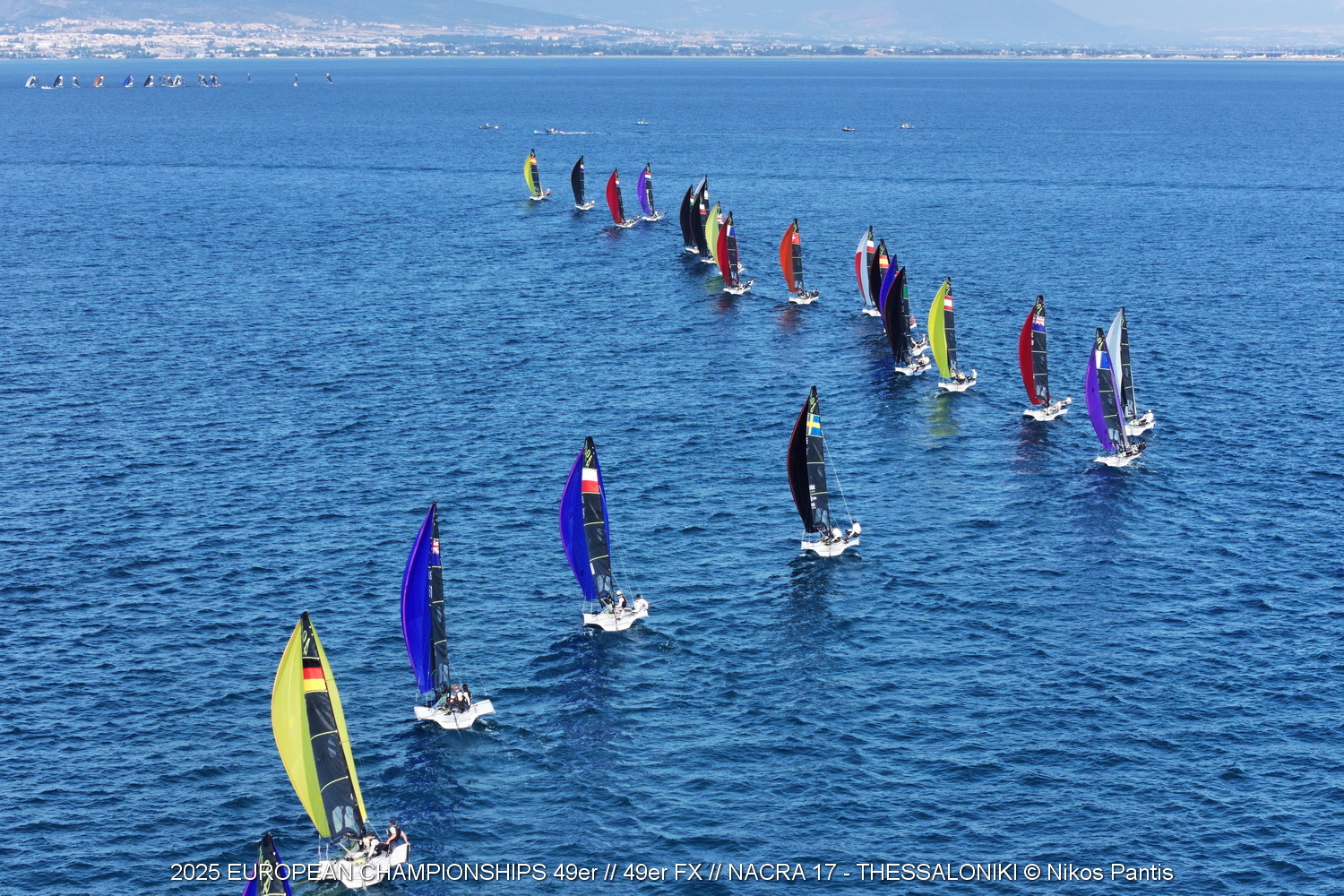
And the fleet is deep enough to keep raising the bar. Forty-plus nations regularly send boats to 49er Europeans and Worlds, which means the same handful of future SailGP drivers spend years racing each other, not just the clock. On the final day of gold-fleet racing at the 2016 World Championship in Clearwater, sailed in big breeze and heavy chop, Burling and Tuke, Outteridge and Jensen, Fletcher, and Botín were all on the same start line inside the top ten. Four future SailGP drivers, from four different SailGP teams, fighting for position in one race, years before any of them had heard of an F50. A shallow talent pool produces one generational sailor once a decade. A fleet that deep produces a pipeline.
A knockout future, already arriving
It’s worth zooming out on the format itself, because qualifying heats followed by a knockout final is where a lot of sailing seems to be heading, not just SailGP. It rewards a boat that peaks at the right moment over a boat that merely survives a long fleet race unscathed. It happens to be close to what sailing’s own Olympic classes were asking for. Sailing’s governing body considered, and ultimately declined, a similar tournament-style qualify-then-knockout format for the Los Angeles 2028 Games. That was championed by two of the sport’s most competitive Olympic fleets before traditional fleet racing was kept instead. SailGP, answering to broadcasters and ticket-buyers rather than an Olympic charter, is now building its future around the same idea Olympic sailing considered and set aside.
The math isn’t hidden
None of this requires guessing at SailGP’s intentions. The league has said the quiet part out loud. Coutts has put “eight and eight” on the record as the plan. Its own split-fleet rule at Portsmouth was a permanent format change, not a one-off fix. And the sport that keeps producing the sailors SailGP actually wants, the fast, foiling, decision-heavy sailors who come up through competitive skiff racing, is racing right now, mostly unwatched, in 49ers from Gdynia to Medemblik to a training base outside Mumbai. SailGP doesn’t have to guess where its next three teams come from. It just has to look at who’s already winning, and who has the bench to keep winning after that.